


Why association CEOs can no longer treat member value and non-dues revenue as two separate problems.
The Association Revenue Imperative
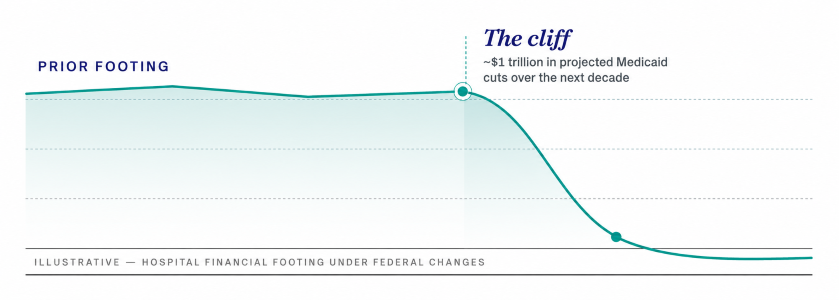
≈$1T
Federal Medicaid cuts projected over the decade
400+
Hospitals at high risk of closing or cutting services
~70%
Of hospitals on thin or negative margins
40–60%
Target share of revenue from non-dues sources
Somewhere in your membership right now, a hospital CEO is sitting with a spreadsheet deciding which service line to close.
Maybe it’s obstetrics. Maybe it’s the rural clinic an hour up the highway. This isn’t hypothetical and it isn’t rare. The reconciliation law passed last year is projected to pull roughly a trillion dollars out of federal Medicaid over the next decade. Work requirements are already live, with members scrambling to help patients prove eighty hours a month before their coverage lapses. Disproportionate share payments are being cut. By one widely cited analysis, more than four hundred hospitals now sit at high risk of closing or eliminating services, and close to seventy percent of hospitals are operating on thin or negative margins.
I’ve spent more than twenty-five years building non-dues revenue programs with state hospital associations, regional councils, and provider societies. I’ve sat through a lot of budget cycles. I have never seen a moment where the distance between what associations sell and what members actually need mattered this much, or held this much opportunity for the executives who see it clearly.
Here’s the uncomfortable part. The non-dues revenue playbook most associations are still running was built for an easier decade.
01 The old playbook now reads as noise
For years, the NDR conversation has been a conversation about selling access. Booth space. Banner ads. Logo placement. The conference tote bag. Sponsorship tiers named after metals. In a good year, a member CFO tolerates all of it as the cost of belonging, and the association books the revenue.
This is not a good year. When a member is deciding whether to keep a maternity ward open, an inbox full of “platinum partner” upsells doesn’t read as value. At best it’s noise. At worst it looks like the association is monetizing attention while members fight to survive.
The revenue professionals who do this for a living have already noticed the shift, the sharper ones are walking away from the low-margin, low-trust products and toward something deeper. They’re right to.
And yet the pressure to grow non-dues revenue has never been higher. Most associations now aim to draw something like forty to sixty percent of total revenue from non-dues sources, and a clear majority name closing the gap between dues and operating costs as their single biggest challenge. So we have a paradox: members can least afford to be sold to at exactly the moment associations most need the revenue.
The thing that helps the member is the thing that pays the association.
02 Value and revenue have converged
When members are under this kind of financial siege, every non-dues revenue decision has to clear a different bar. The old question was, “Will a vendor pay for this?” The new question is, “Does this help a member protect a dollar, save a dollar, or make a dollar?”
Get that right and the supposed tension between member value and non-dues revenue simply collapses. A program that cuts a member’s contract-labor spend, tightens their revenue cycle, hardens their cybersecurity, or helps them navigate the new Medicaid documentation rules is not a trade-off against revenue. It is the revenue. For the first time in a long time, the mission and the margin point in the same direction, if you build the program to.
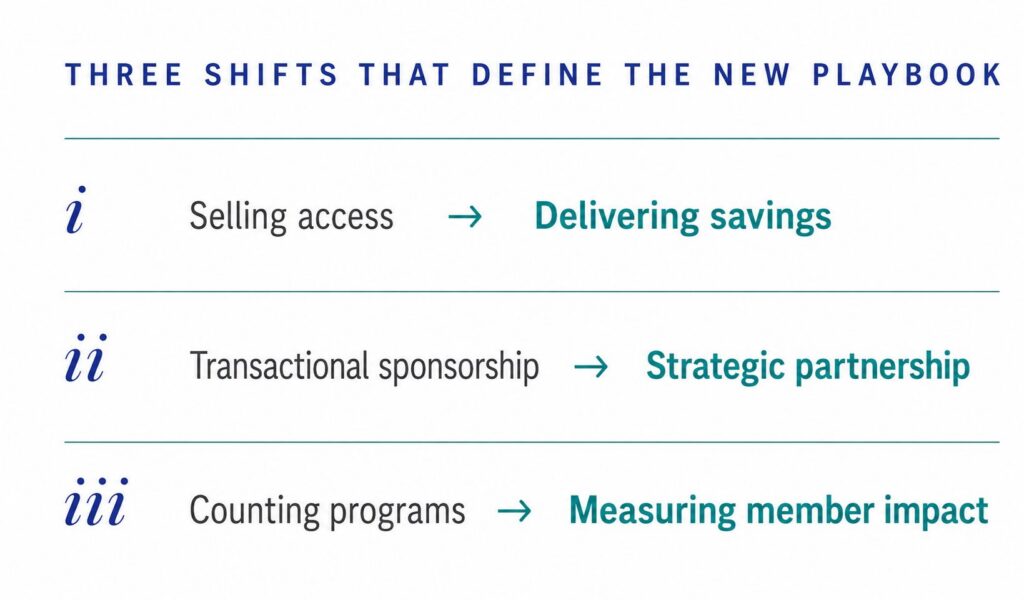
From selling access to delivering savings. Your most valuable non-dues asset is not your audience. It’s your trust. A margin-pressured hospital CFO will not take the cold vendor call, but they will look hard at a solution their state association has vetted and is willing to stand behind. An endorsed-partner program built on genuine due diligence, not a pay-to-play badge, turns the association into a procurement filter members rely on. That’s worth real money to the right partners precisely because it’s worth real money to members.
From transactional sponsorship to strategic partnership. The momentum has moved from giant exhibit halls to smaller rooms with the right decision-makers in them, and from one-off booth sales to year-round relationships. Sponsors will pay more to be in a small room with the people who actually sign contracts than to be one banner among forty. Build a handful of deep, multi-year partnerships organized around your members’ real problems and you’ll out-earn a sponsorship grid that takes three times the staff effort to sell.
From counting programs to measuring member impact. Stop reporting non-dues revenue as a single line on the association’s budget and start reporting it as dollars returned to members. How much did the group purchasing arrangement save the membership last year? How many revenue-cycle dollars did the endorsed partner recover? When you can put that number in front of your board and your members, your NDR program stops being overhead and becomes one of the most defensible things the association does.
03 Your advocacy is your most tangible value
There’s one more piece, and it’s the one too many associations under-tell. The single largest thing on a member CEO’s mind right now is the financial threat coming from Washington and the statehouse. The advocacy your association funds, much of it underwritten by non-dues revenue, is the most concrete value you deliver in this environment.
But only if you tell the story the way a CFO hears it.
Members don’t renew because you “tracked forty-two bills.” They renew because a provider-tax fix you fought for protected eight figures of reimbursement, or because a rate cut got softened, or because a member walked into a rural health transformation funding opportunity you helped them find. Translate advocacy into dollars protected and you accomplish two things at once: you strengthen retention, and you make the case for the non-dues programs that fund the advocacy in the first place. The two reinforce each other.
04 The real question for association leadership
The associations that come through this period stronger won’t be the ones that simply sold more sponsorships. They’ll be the ones whose CEOs stopped managing non-dues revenue as a budget line and started managing it as a member-survival strategy.
The question to put to your team this quarter
If we listed every non-dues program we run, how many of them would a member CFO, the one staring at that closure spreadsheet, describe as something that protected, saved, or made them money?
If the honest answer is “not many,” that’s not a problem. In this environment, it’s the single biggest opportunity on your strategic plan.
Brian Stevens is President and CEO of Affiliated Enterprise Solutions, which helps state hospital and healthcare associations build, develop, and manage their non-dues revenue programs.
Sources: Federal reconciliation law projections; Public Citizen at-risk-hospital analysis; KFF.